Thursday, 18 August 2011

What is TTP?

An explanation for the newly diagnosed patients and families
I can still remember the haematologist trying to explain Thrombotic Thrombocytopenic Purpura (TTP) to me when I first was diagnosed in May 2010. I remember me thinking…… huh? Many people know about Cancer, heart attacks, Alzheimer’s, and stroke, but I haven’t met a TTP patient yet that had previously heard about it.
So the simple answer in layman’s terms, because I am by no means a medical doctor, is that it is a rare and life-threatening blood disorder where we form small blood clots that :
1.      cut-off nutrient rich blood flow to vital organs which may lead to heart attack, stroke, kidney damage etc.
2.      use up our platelets so they are not available to seal sites of injury
3.      shear our red blood cells which makes us feel tired

Patient Information Leaflet

But I can’t recall the use of a simple explanation when I was diagnosed. Only something about ADAMTS13 and Von Willebrand factor… I know that I was confused about things at the time. Perhaps it was as a result of the TTP - symptoms or shock I will never know exactly. If you are a TTP patient diagnosed since March 2011, I hope that you received the information leaflet produced by Answering TTP Foundation. This is a valuable resource that wasn’t available yet for me. I really needed the support of another patient like me, someone that could understand what I was going through and give me some startup information.
So what have I learned about TTP since this original puzzling encounter with my haematologist?
Most TTP cases are autoimmune, including mine. The immune system is a vital part of our body’s defences. We produce antibodies in our blood by means of our immune cells that identify and target abnormal cells, viruses and/or bacteria for elimination from the body. Once our antibodies identify something as abnormal our body amplifies the response to start pumping out more and more antibodies from active cells to help fight the infections. We describe most cases of TTP as an autoimmune condition because our immune cells mistakenly identify part of our body as abnormal and pump out antibodies to eliminate it. In this case of mistaken identity we’ll refer to “it” as the “victim”.  For most autoimmune TTP cases scientists have identified at least one of these “victims” to be an important enzyme called ADAMTS13.


Fence Lattice

When the immune system attacks the ADAMTS13 enzyme we become deficient and do not have enough of it to perform its job in the body. The job of the ADAMTS13 enzyme is to break down and/or control the size of blood clots. Without proper amounts of this enzyme, platelets along with other blood factors begin the clotting process but are not controlled and so continue to bind our platelets forming a mesh-like structure (think of it as the criss-cross structure like the lattice decoration on a fence). Not only do these meshes reduce blood flow and use up our platelets, but the structure itself shears red blood cells (oxygen carrying cells in our body).  View a video animation by clicking here.
TTP is treated with:
  • plasma exchange therapy to replace our antibody rich plasma with that of healthy plasma from blood donors. Unfortunately, this plasma exchange therapy needs to be repeated until the immune system returns to normal. Research suggest that additional building blocks of plasma (not always and potentially not the ADAMTS13 enzyme only) may also be affected by TTP.  Therefore, we need more research to define why people respond differently to treatment and what other factors are involved.  Some patients respond well to plasma exchange, whereas others never really respond until other treatments such as splenectomy, Rituxamib, Vincristine and/or Cyclosporine are explored.
  • Prednisone  to calm the immune cells releasing antibodies in the response.
In 80%- 90% of cases, these treatments eventually work to stop the immune attack. But the immune system has, just like our brains, a memory to it; if we see something similar in the future our body always can have the ability to attack the ADAMTS13 enzyme again.
We have discussed how this happens, but what makes our body start attacking the ADAMTS13 enzyme, make it a ”victim” of our immune system, in the first place?
That is a good question and if you are like me you have no clue. It is likely that at some point we were exposed to something in our environment that resembled this ADAMTS13 enzyme  and for some reason we were unlucky enough that our immune cells couldn’t tell the difference and started attacking ADAMTS13 as well. Whether this was from pregnancy, a virus, something we ate, or got exposed to in the environment only your doctors might be able to suggest.
On September 24, 2011 I am participating in the Walk to Answer TTP Together to help raise awareness and funds for TTP research. There is so much more to learn about this deadly complex disorder and it is a good opportunity to share stories and support each other as patients. I hope you will come out and walk with us!

Written by Dianna Martin

Friday, 22 July 2011

A Call for Patient Stories to Help Raise Awareness for Thrombotic Thrombocytopenic Purpura, TTP

When TTP strikes it is considered a true medical emergency. Early diagnosis is the key to saving lives and reducing the potential for irreversible, life-altering complications. But diagnosis can be delayed because awareness for TTP is low. TTP symptoms can look like a multitude of other more common and less dangerous conditions. Both patients and doctors can be fooled. As a patient organization, Answering TTP Foundation has come to know of too many patients that are diagnosed too late. We’ve met families who have lost, and families who continue to struggle with irreversible complications.
One of the best ways to raise awareness for TTP is for TTP patients and supporters to share their experiences. Personal stories are interesting to the public. Facts are boring. We need you to share your experience to help raise awareness for TTP. Please share your TTP experience with us today!
Sharing such a devastating and scary time can seem like a daunting task. Where do you begin? I think the first half-page draft of my experience with TTP was one of the hardest things I’ve ever written. It took me forever! I knew the value of sharing my experience, but I was worried that people would feel sorry for me, or that they would think I was complaining. In reality, people have been genuinely interested in learning about TTP, and once they hear my story they want to help improve the prognosis for all TTP patients.
If you are a fellow TTP patient or supporter I encourage you to pick up a pen and just start writing, or these days turn on your computer and get typingJ Try not to judge your words at the outset. Get the facts and main points you want to cover down on the page. Then start to fill in the details. Don’t be afraid to walk away for a day and come back to it. Have someone read it over for you. For ideas visit http://www.answeringttp.org/ and read through other patient stories. We have also compiled some tips to help you. Click here for detailed story submission instructions.


Prior to diagnosis I’d never heard of this three letter acronym before. Many TTP patients attribute their lives to chance - pure luck that they ended up at a medical facility that could recognize the symptoms of TTP quickly. I credit my mom for pursuing a second opinion after I was diagnosed with a migraine at a major city-centre emergency room.
Sharing your story could save a life.

Thursday, 10 March 2011

Roadshow: Vancouver, British Columbia

On Friday March 4, 2011 I was greeted by my sister, Stacy, at the Vancouver airport.  This was the last stop on the Answering TTP Roadshow west. Not only was I able to meet with medical staff at Vancouver General Hospital, VGH, but we were also able to arrange a support group session with local patients and supporters.

Dr. Yenson, Me, Dr. Streenivasan, & Dr. Zypchen
Unfortunately my first impression on the Vancouver doctors on Friday did not go as smoothly as I had hoped. Despite leaving over 30 mins to make the 10 minute drive to the hospital we made a wrong turn and arrived 15 minutes late. Dr. Yenson, Dr. Streenivasan, and Dr. Zypchen were all very kind and understanding. Moreover, they are supportive of our efforts and have agreed with the value of handing out the new TTP patient brochures at their hospital. In 2010 their centre treated 11 new TTP patients and 3 relapsed TTP patients with 136 Apheresis treatment procedures. Over the past 20 years, the center has treated 168 TTP patients.

After the meeting with the doctors, I was fortunate to meet up with another TTP patient and his wife to share our experiences over tea. Bill and Marjorie are kind people who have volunteered with the Southern Okanagan Association for Integrated Community Living for many years. Last year they were enjoying a cruise of the Panama Canal  when Bill was struck ill with what the ship’s doctor thought was only a virus.  Bill’s altered mental status tipped Marjorie off to his need for medical attention. Bill does not recall time between leaving the ship and starting treatment for TTP at VGH. Both Bill and Marjorie feel very fortunate that a doctor, trained at VGH, recognized the signs of TTP near their small hometown over 5 hours from Vancouver. Bill's full story will soon be available on the Answering TTP website.

Vancouver TTP Support Group Participants
The next morning I felt well rested and excited for the patient support group session. We arrived more than 15 minutes early to meet Dr. Yenson to prepare the meeting space and set out the snacks and coffee. The meeting was a success. There were 6 patients, 4 supporters, Dr. Yenson and Dr. Benny in attendance. Dr. Yenson gave an overview of TTP, participants asked questions and shared their experiences with TTP, and I discussed my experience and the founding of the Answering TTP Foundation.
 
A reoccurring question that surfaced again today during discussion was that of relapse. ‘Will TTP patients be able to recognize the symptoms of a TTP relapse?’ Unfortunately the answer to this question isn’t black and white. Most participants took part in this discussion topic. It seems that talking about it together helps. I was relieved to hear that I’m not the only one who looks in a full length mirror on a regular basis to check for bruising. Bruising was one of the first signs I should have noticed during my first TTP episode. Moreover, it helps to know that some patients seem to display a similar pattern of symptoms upon relapse. Recognizing this pattern of symptoms early and seeking medical attention quickly, can mitigate risk of irreversible damage from TTP.

During this support group session I recounted my experience battling TTP three times thus far and how this fight has outlined opportunities to improve the prognosis for all TTP patients. Answering TTP Foundation has been established to provide a national framework to connect all TTP stakeholders across Canada, and with the international community to leverage these opportunities together. Involvement can start as simply as joining the Answering TTP community and sharing your story. Patients are also encouraged to help start local support group and fundraising initiatives utilizing supportive resources from the Answering TTP Foundation. Together we can help improve the prognosis of TTP.

After the support group session I met up again with Bill and Marjorie, and another TTP patient, Iveta, for lunch.  We remarked that TTP doesn’t care about your age, gender or background. It can happen to anyone at anytime.

I can honestly say that the Answering TTP Roadshow west has been even more successful than I had imagined. I am sincerely grateful to friends and family who have helped us to successfully connect with the TTP community in each of the visited provinces to jump-start local initiatives.  Now it is time to plan the Roadshow east. Stay tuned!

Sunday, 6 March 2011

Roadshow: Calgary, Alberta

On Thursday March 3, 2011 I experienced the first flight delay. At least 1 delay was inevitable with 7 flights scheduled in 9 days to complete the Answering TTP Roadshow west. Fortunately my meeting scheduled with the Calgary doctors had been pushed back to mid afternoon. I was able to make effective use of the delay; I found a desk with internet access tucked around a corner in the Edmonton airport. After catching up on emails and posting yesterday's blog the new plane pushed back from the gate for the quick 1 hour flight to Calgary.

I met with an Apheresis  Nurse Lorraine, Dr. Klassen and Dr. Duggan at the Foothills Medical Centre in Calgary. The Apheresis department is equipped with 4 Apheresis machines used for various treatments including TTP. So far in 2011 the Apheresis department at Foothills has treated 5 TTP patients, which was indicated to be off to a busier start than previous years.

Like the other 18 or so Canadian Apheresis treatment centres, all Apheresis treatments are recorded and submitted to the Canadian Apheresis Group, CAG, for consolidation of statistics. The CAG is chaired by Dr. Rock and includes members from about 40 Apheresis units in the 19 major medical centers in Canada. Moreover, the CAG promotes international communication of best practices and ideas through its relationships with the World Apheresis Association. Answering TTP Foundation is thrilled that we have been asked to attend this year's meeting, in April 2011, to provide information regarding our newly formed, nationally structured, and purely volunteer patient organization.

I am happy to write that the medical staff in Calgary have decided to hand out the new patient brochure. They agree that providing educative materials and the ability to connect with other TTP patients is valuable.

Dr. Klassen & Dr. Duggan
During my conversation with Dr. Klassen and Dr. Duggan, we discussed some of the lingering worries TTP patients carry with them every day. Probably one of the biggest concerns is that of relapse, in particular many patients worry, ‘Will I recognize the symptoms of relapse?’ One of the values of a patient organization is that we can provide some piece of mind to each other. Patients are not alone in their worry. Sometimes the ability to talk about it with others who share the same diagnosis can reduce this stressor. 

Another interesting and successful stop for the Answering TTP Roadshow west. 

Thursday, 3 March 2011

Roadshow: Edmonton, Alberta


Gaining an additional hour is definitely an advantage of traveling west. I was able to leave Saskatoon at 10:30am and arrive at the same local time in Edmonton which meant that I got to sleep in!


My cousin Susan met me at the airport to accompany me on my meetings at the University of Alberta Hospital. We were able to meet with a local Apheresis nurse, a newly diagnosed TTP patient and her 8-week-old baby, and a local doctor.

Terri & Sydney
The University of Alberta Hospital treated 10 TTP patients in 2010. According to local Apheresis Nurse Terri, this was a pretty average number for their facility to see in one year. I am thrilled to report that Terri is interested in Answering TTP initiatives and received confirmation from Dr. Qarni, a local TTP doctor, to distribute our new patient brochure.  Our meeting with Terri took place in the Apheresis unit of the hospital. The room looked to accommodate 1 treatment bed and an office area for nursing staff to complete paperwork.  Like the Apheresis unit I am treated in, at Saint Michael’s Hospital in Toronto, pictures of the children of locally treated TTP patients were hung on the cabinets giving the room a friendly atmosphere.

We were able to meet with a newly diagnosed TTP patient and mother, her 8-week-old baby and family. She has been fighting strong since the birth of her beautiful little girl. Readmitted to hospital recently, she said that the hardest part is saying goodnight to her baby, who is cared for at night by her supportive husband. This new little family is not from Edmonton and is eagerly awaiting their ability to travel home. Moreover, mom and baby hope to travel to visit friends and family across the country during mom’s maternity leave but fear of relapse may interfere with previous plans. The family had a number of thoughtful questions concerning my experience, available treatments and triggers. To supplement the visit I left them with one of the new patient brochures and I sincerely hope that they reach out to connect with us via the Answering TTP community.

The Lab
Dr. Ritchie is a local doctor who treats some TTP patients. I met him previously at the NRBDO (Network of Rare Blood Disorder Organizations) conference in Toronto last November. Dr. Ritchie expressed his support of patients advocating for their care. Dr. Ritchie provided us a tour of his laboratory which includes a biobank holding 600,000 samples in an approximately 12 x 24 foot space. 


Biobank Room
"Hotel" Storage
Sample Log
Each sample is accurately bar-coded, logged into a redundant system and stored to ensure reliability. Each step to log a sample in or out of the biobank is recorded and optimized for automation where appropriate. The tour of his facility is particularly interesting to start the foundations research regarding biobanking for TTP. A biobank forms a foundation for research, as samples are used to test research theory.


It was an enlightening day in Edmonton. We were able meet with key communicators at the hospital and lend some support to a new patient and her family. Moreover, I’d never toured a biobank facility before, and my engineering background loved the opportunity. Seeing one gives more perspective to a potential biobanking project for TTP. Thank you very much to my cousin Susan for her time and interest in our cause.

Wednesday, 2 March 2011

Roadshow: Saskatoon, Saskatchewan

Today started bright and early with a drive through a Winnipeg blizzard to catch a 7am flight to Saskatoon via Calgary. Now you are probably wondering why I flew all the way to Calgary and then went back east to Saskatoon. Seems counterproductive right? The short answer is airfare.  I elected to save close to $1,000 to sacrifice an additional 3 hours to travel time. The strange thing is, I wanted to prove it with today’s pricing and it looks like you can fly direct starting tomorrow for $199. Jokes on me I guess.

Mr.  Doug Richarson of McKercher LLP, a caring and determined friend of one of our Answering TTP Board Members, Alexis Levine of Blake, Cassels & Graydon LLP, was there with a nice warm coffee to meet me. The warm coffee tasted better than ever; maybe that had something to do with being awake at 5am or the temperature that was into the minus thirties! 

We drove to meet with Dr. David Poulin, Vice President, Medical Affairs, Saskatoon Health Region who was filling in for Jean Morrison, President and CEO of St. Paul’s Hospital during his vacation. Dr. Poulin was very responsive to my presentation and happy to help organize further meetings with medical staff.

Our next meeting was kindly organized through Nurse Jennifer Larson. She assembled a receptive and caring group of medical staff consisting of herself, another nurse, Dr. Mainra and a social worker. It was new and valuable to include a social worker. She was able to bring another perspective to the meetings that reaffirmed our belief in the value of connecting new patients with the community in an effort to mitigate feelings of isolation. In the past couple of years there have only been a small handful of TTP patients treated at St. Paul’s. What is interesting is that ½ of these cases were male; TTP has been known to occur predominantly in females.

At the end of the day I was able to catch up with Dr. Otto Moodly who was very receptive to the Answering TTP initiatives including the distribution of the new TTP patient brochures, described in more detail in my last blog entry. Dr. Moodly emphasized the need for rare disease groups to form a unified group to help research and a unified voice to help ensure access to new treatment options despite the price tag these new drugs for rare disorders usually have.

Today has been filled with new and sincerely interested people. I look forward to their feedback to help continue to develop our initiatives. Definitely a successful day in Saskatoon.

Tuesday, 1 March 2011

Roadshow: Winnipeg, Manitoba

Sydney Interviewed by CityTV
February 28, 2011 has marked, not only the globally recognized 4th Rare Diseases Day organized by EURORDIS, but also the start of the western leg of the Answering TTP Roadshow. We have connected with a local TTP doctor, an Apheresis nurse, two TTP patients and the media. CityTV had a feature story on Tuesday's Winnipeg Breakfast Television show featuring TTP, click here to view it.

 
CityTV Reporter Kaleigh Hamilton with Lisa her mom.
Lisa Interviewed by CityTV


I met with Dr. Moltzan, a doctor treating TTP patients at Saint Boniface Hospital, and Brenda, an Apheresis Nurse, to introduce them to our patient organization. I am thrilled that they will be passing out the new TTP patient brochure. This brochure is an educational resource for patients and supporters. It is available to all TTP treatment centres for them to distribute to patients. Moreover, the brochure contains information about our patient group and how patients and supporters can reach out to us.  We look forward to the response from these brochures to help initiate local patient support activities.

Chris & Lisa
Canadian Blood Services helped to organize a media event with myself, a local TTP patient and Bill Coleman, Director of Donor  and Clinic Services for the Prairies. We were successful in attracting attention from local CTV and CityTV television stations. Check out CityTV's coverage by clicking here. Lisa Nield is a local TTP patient who has shared her story nationally to raise awareness for the need for blood donors. Her calm positive confidence in front of the cameras was inspiring. I can definitely learn a lot from her. She, like many of us TTP patients, has a frightening story to tell and she has agreed to share it first hand with us on the Answering TTP website, so stay tuned. Her story is that of courage and hope. It took over 700 blood donations for her to obtain remission.  Ten years later she is a bright eyed mother to be. Her and her husband, Chris Mcivor, continue to give back by raising awareness regarding the need for blood and thanking those selfless strangers who do.

CBS starts their Sirens for Life initiative in Winnipeg tomorrow for the month of March. It is a fun and competitive competition between the Winnipeg Fire Paramedic Service and the Winnipeg Police Service. The challenge is in its sixth year and has a goal of obtaining 125 donations; up from the actual 117 obtained last year. Good luck to all participants!

Sydney & Karen Black
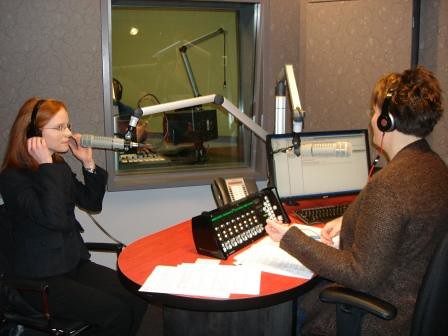
After a quick meal of rice paper rolls at a local Vietnamese restaurant, YUM!, we were off for my radio debut. I admit I was nervous. My chest would pound when I even raised my hand during a class at school. Now I was going to be on live radio! CJOB is the local number one  station in Winnipeg and Karen Black asked me on her show, The Drive with Karen Black. Walking into the studio my nerves, not the -15oC weather, shook my body. But Karen’s fun and laid back demeanor had me feeling myself again relatively quickly. She even introduced me to a fellow TTP patient who works at their studio. After the CJOB interview, we were off to CBC Radio for another live interview with Larry Updike. During both interviews I was able to explain TTP, raise awareness for the need for blood and personalize the disorder by sharing snippets of my story.

It was a great visit to Winnipeg. I could not have done it all without the help of my Aunty Janis. She kept me calm, well fed and on schedule. Moreover, Adrienne Silver from Canadian Blood Services was instrumental in organizing the media initiatives. Thank you to everybody who helped make today possible. I feel very lucky and energized for my 7am flight to Saskatoon tomorrow!  Goodnight.