Saturday, 31 December 2011

Looking Back on a Very Successful 2011


Happy New Year to Everyone! 2011 has been a successful growth year for Answering TTP Foundation. Thank you to all involved. We are excited for 2012!

2011 Highlights
  • PATIENT SUPPORT
    • NEW TTP Patient Brochures were distributed and promoted during the Rare Diseases Day Roadshow. These informational brochures explain TTP in simple terms and advise patients of our support programs. Hard copies are shipped free of charge to TTP treatment centres for distribution to patients.  Translated versions, in French and German, are available for download from www.AnsweringTTP.org.
    •  Local Support Groups were organized in both Vancouver (March 2011) and Toronto (April & October). Click for details.
      Toronto Support Group
      • Electronic Quarterly Newsletters featuring patient and supporter stories, as well as current issues and Answering TTP Foundation updates were distributed to a growing Answering TTP Community network (now almost 1000 strong). Click to register for yours.
      • Patient -to-Patient Outreach has begun connecting TTP patients to provide peer support via telephone or email. A toll free patient peer support line has been established to help newly diagnosed patients reach out 1-888-506-5458.
    • PATIENT ACCESS
      • Solvent Detergent Plasma. Answering TTP Foundation assembled a team to provide patient feedback to the CADTH draft report regarding the availability of Solvent Detergent Plasma in Canada. Click here for CADTH information. The team surveyed the Answering TTP Community to provide insight from as many patients as possible. Answering TTP Foundation has been notified that preparations are currently underway to make Solvent Detergent Plasma available in Canada in 2012.
    •  BLOOD DONATION
      • Partners for Life with Canadian Blood Services ID # ANSW011432. Blood donors are encouraged to join the Answering TTP Blood Donation team to help replenish the massive amount of blood product critical to the treatment of each TTP patient crisis. Click here for details.
      • Volunteer Speakers Bureau. Answering TTP Foundation patient volunteers share their stories at lunch'n learn sessions hosted at various corporate offices to help encourage blood donation.
      • Big Save Event. Answering TTP Foundation patient volunteers participate in Canadian Blood Services biggest blood drive ever at the Air Canada Centre which raised 574 units!
    • FUNDRAISER EVENTS
      • June 4, 2011: Chance & Change Game Night raises $80 000 for TTP research. It took a team of 20 dedicated volunteers, the generosity from over 100 guests and additional donors, numerous corporate gold, silver and bronze sponsors and program advertisers.


      • September 24, 2011: Walk to Answer TTP Together was a great success. We raised awareness and $22 000 for TTP. 70 participants from Canada, US and Europe walked "together" in their local communities.
      • Ongoing: TTP Denim Days have raised almost $4000 to date for TTP. These prepackaged fundraisers engage the TTP community to educate their communities about TTP. 
    • IN THE NEWS
      • Roadshow West jump-started Answering TTP Foundation's initiative to connect with the geographically dispersed TTP patient and medical community. The kickoff with Canadian Blood Services in Winnipeg resulted in much needed TTP awareness in the form of print articles, radio interviews and a TV spotlight featured on Breakfast Television. 
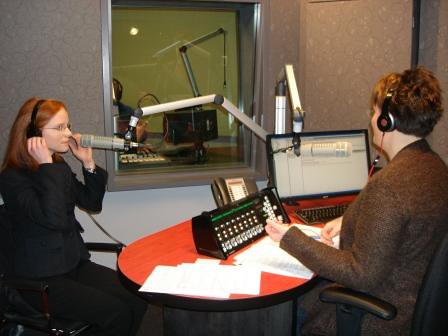
    Sydney & Karen Black at CJOB in Winnipeg
      • Georgia Straight, Vancouver, Thrombotic Thrombocytopenic Purpura strikes and patients act, by Gail Johnson, May 4, 2011. Click for full article.
      • Globe and Mail, Toronto, Blood Disease: It's hard to raise funds for a rare illness, by Paul Waldie, Dec 5, 2011. Click for full article.


    _________________________


    Remember our call for applications to join our team! 
    We have a great deal of opportunity to translate into action to help improve the prognosis for all TTP patients.  


    Our organization is in a grass roots growth phase that will provide you with great opportunity; whether you are new to the workforce and are looking for experience towards your resume, or you are a seasoned professional looking to lend your skills to a worthy cause. Applications are due Jan 6, 2012. Click here for details.

    Volunteer positions include: Outreach Coordinator, Communications Specialist, Finance Team Chair, Volunteer Coordinator, Walk Team Chair, Sponsorship Coordinator and Local Support Group Coordinator. Volunteer from anywhere in the world! Apply today. Contact Sydney@AnsweringTTP.org with any questions.


    Thursday, 18 August 2011

    What is TTP?

    An explanation for the newly diagnosed patients and families
    I can still remember the haematologist trying to explain Thrombotic Thrombocytopenic Purpura (TTP) to me when I first was diagnosed in May 2010. I remember me thinking…… huh? Many people know about Cancer, heart attacks, Alzheimer’s, and stroke, but I haven’t met a TTP patient yet that had previously heard about it.
    So the simple answer in layman’s terms, because I am by no means a medical doctor, is that it is a rare and life-threatening blood disorder where we form small blood clots that :
    1.      cut-off nutrient rich blood flow to vital organs which may lead to heart attack, stroke, kidney damage etc.
    2.      use up our platelets so they are not available to seal sites of injury
    3.      shear our red blood cells which makes us feel tired
    
    Patient Information Leaflet
    
    But I can’t recall the use of a simple explanation when I was diagnosed. Only something about ADAMTS13 and Von Willebrand factor… I know that I was confused about things at the time. Perhaps it was as a result of the TTP - symptoms or shock I will never know exactly. If you are a TTP patient diagnosed since March 2011, I hope that you received the information leaflet produced by Answering TTP Foundation. This is a valuable resource that wasn’t available yet for me. I really needed the support of another patient like me, someone that could understand what I was going through and give me some startup information.
    So what have I learned about TTP since this original puzzling encounter with my haematologist?
    Most TTP cases are autoimmune, including mine. The immune system is a vital part of our body’s defences. We produce antibodies in our blood by means of our immune cells that identify and target abnormal cells, viruses and/or bacteria for elimination from the body. Once our antibodies identify something as abnormal our body amplifies the response to start pumping out more and more antibodies from active cells to help fight the infections. We describe most cases of TTP as an autoimmune condition because our immune cells mistakenly identify part of our body as abnormal and pump out antibodies to eliminate it. In this case of mistaken identity we’ll refer to “it” as the “victim”.  For most autoimmune TTP cases scientists have identified at least one of these “victims” to be an important enzyme called ADAMTS13.
    
    
    Fence Lattice
    
    When the immune system attacks the ADAMTS13 enzyme we become deficient and do not have enough of it to perform its job in the body. The job of the ADAMTS13 enzyme is to break down and/or control the size of blood clots. Without proper amounts of this enzyme, platelets along with other blood factors begin the clotting process but are not controlled and so continue to bind our platelets forming a mesh-like structure (think of it as the criss-cross structure like the lattice decoration on a fence). Not only do these meshes reduce blood flow and use up our platelets, but the structure itself shears red blood cells (oxygen carrying cells in our body).  View a video animation by clicking here.
    TTP is treated with:
    • plasma exchange therapy to replace our antibody rich plasma with that of healthy plasma from blood donors. Unfortunately, this plasma exchange therapy needs to be repeated until the immune system returns to normal. Research suggest that additional building blocks of plasma (not always and potentially not the ADAMTS13 enzyme only) may also be affected by TTP.  Therefore, we need more research to define why people respond differently to treatment and what other factors are involved.  Some patients respond well to plasma exchange, whereas others never really respond until other treatments such as splenectomy, Rituxamib, Vincristine and/or Cyclosporine are explored.
    • Prednisone  to calm the immune cells releasing antibodies in the response.
    In 80%- 90% of cases, these treatments eventually work to stop the immune attack. But the immune system has, just like our brains, a memory to it; if we see something similar in the future our body always can have the ability to attack the ADAMTS13 enzyme again.
    We have discussed how this happens, but what makes our body start attacking the ADAMTS13 enzyme, make it a ”victim” of our immune system, in the first place?
    That is a good question and if you are like me you have no clue. It is likely that at some point we were exposed to something in our environment that resembled this ADAMTS13 enzyme  and for some reason we were unlucky enough that our immune cells couldn’t tell the difference and started attacking ADAMTS13 as well. Whether this was from pregnancy, a virus, something we ate, or got exposed to in the environment only your doctors might be able to suggest.
    On September 24, 2011 I am participating in the Walk to Answer TTP Together to help raise awareness and funds for TTP research. There is so much more to learn about this deadly complex disorder and it is a good opportunity to share stories and support each other as patients. I hope you will come out and walk with us!

    Written by Dianna Martin